Construction Turnstiles vs Manual Sign-In

A manual sign-in system relies on workers writing their details in a book or on a tablet, which is slow, easy to falsify and hard to rely on in an emergency. A construction site sign-in system built on access control turnstiles verifies each worker at the gate, logs every entry and exit automatically, and produces an accurate live record of who is on site. For most sites, turnstiles deliver stronger security, better compliance and far less admin.
Most construction sites still track site attendance with a sign-in sheet or a tablet at the cabin door. It is simple to set up, but it depends entirely on people remembering to sign in and out honestly. This article compares manual sign-in with turnstile access control across the things that matter on a live site: security, compliance, emergency safety and administration, and it explains how the CloudPass kiosk bridges the gap when a site is not yet ready for a turnstile.
What is the difference between manual sign-in
and turnstile access control?
Manual sign-in is a record-keeping method. Someone writes down who arrived and when, either on paper or through a digital form. Nothing physically stops an unauthorised person walking on site, and the record is only as accurate as the honesty and memory of the people using it.
Turnstile access control is a physical and digital system. A worker verifies their identity at the gate with a card, fob or facial recognition, and the turnstile releases for a single entry. The event is logged automatically. In other words, manual sign-in records what people say they did, while a turnstile records what actually happened. Envision’s security access control turnstiles, powered by CloudPass, combine both the physical barrier and the digital record in one system.
Security: who can
actually get on site
The biggest weakness of manual sign-in is that it controls paperwork, not access. Anyone can walk past an unattended sign-in sheet, and a signature proves nothing about identity or eligibility. On a busy site with subcontractors coming and going, that is a real risk to expensive plant, materials and workforce safety.
Turnstiles only release for inducted, authorised workers. Anti-pass-back technology stops one card being shared between several people, which removes ghost workers and tailgating in a single step. For larger or higher-risk sites, turnstiles work best alongside construction site access control systems and temporary CCTV for construction sites, giving you perimeter-to-personnel coverage rather than a single point of control.
Compliance and
workforce records
Main contractors increasingly need to prove, not just claim, that everyone on site is inducted, competent and eligible to work. Manual records are hard to audit, easy to lose and often incomplete. When a client or insurer asks for evidence, a pile of paper sheets is a poor answer.
A turnstile system running CloudPass keeps a clean digital audit trail of every entry and exit, tied to a verified identity. It holds inductions, validates CSCS cards through Smart Check, confirms Right to Work through PPAC, and denies access automatically when a certification has expired. That makes compliance reporting straightforward and defensible.
Emergency safety
and fire roll call
In an evacuation, a manual sign-in sheet is often out of date, sitting in a cabin that may not be safe to reach. Turnstile data produces an instant, accurate fire roll call of exactly who is on site at that moment, viewable on any device or printed with a page per subcontractor, which supports your emergency procedures and demonstrates proactive control. This safety advantage alone is why many main contractors move away from paper. We cover it in detail in our guide to construction site turnstile hire.
Administration and cost
Manual sign-in looks cheap because it has no equipment cost, but the hidden cost is admin. Someone has to collate sheets, chase missing entries, cross-check timesheets and store the records. Turnstiles automate attendance, validate timesheets and payroll, and remove hours of manual logging each week, freeing site managers to focus on the build.
The middle ground: the CloudPass kiosk and
manual check in
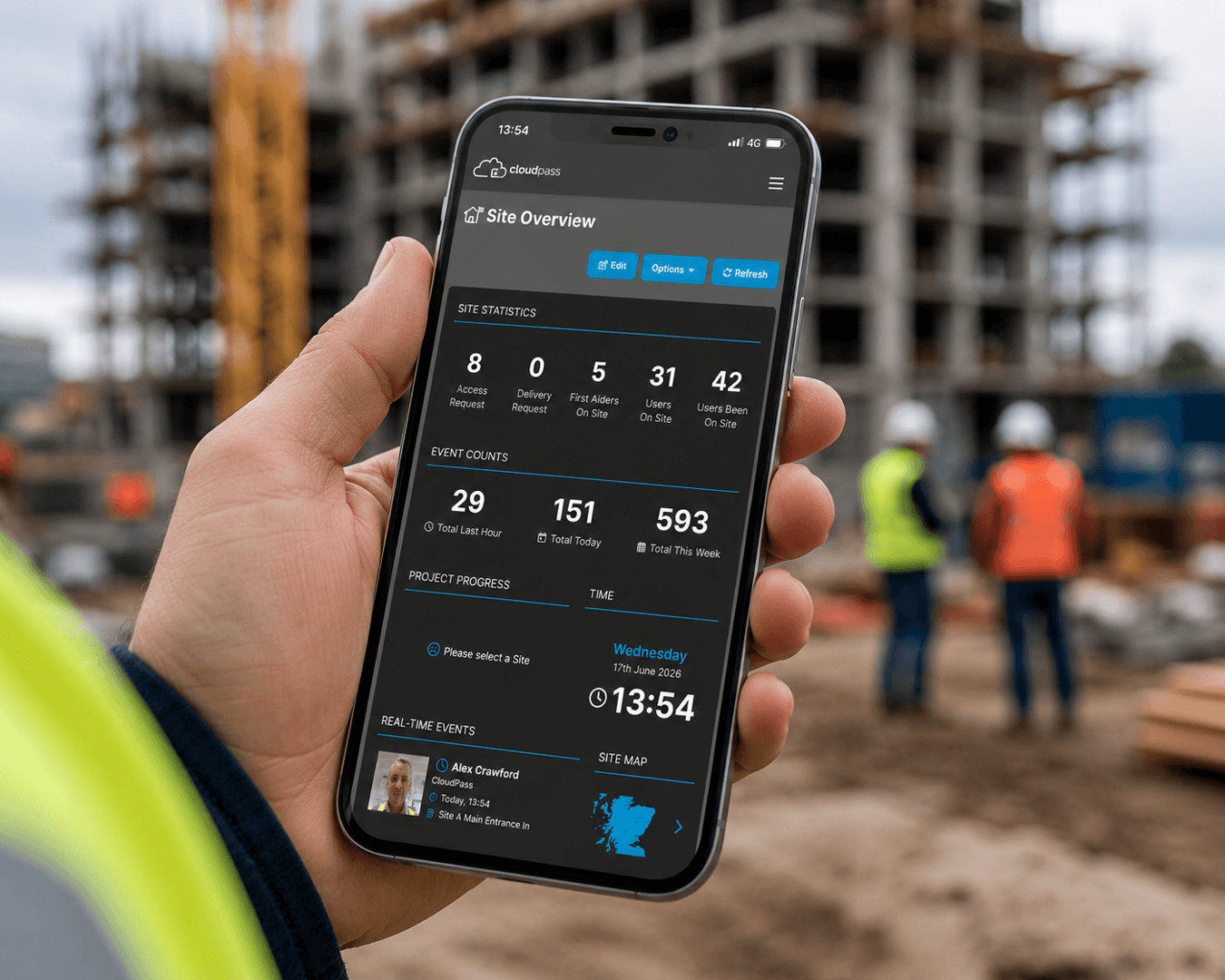
A turnstile is not always possible from day one. Some sites have no power for the first few weeks, no space for a barrier, or a phase of work that does not justify one. This is where the CloudPass kiosk and manual check in come in. They capture the same workforce data as a turnstile, digital records, live attendance, certification checks and an accurate fire roll call, just without the physical barrier and security. It means fit-out contractors, groundworks teams and smaller sites are not left with paper simply because a turnstile is not practical yet, and the kiosk can later work alongside a turnstile to zone the site. In short, you get the CloudPass benefits from day one and add the physical security when the site is ready.
Turnstiles vs manual sign-in
at a glance
|
Factor |
Manual sign-in (paper) |
CloudPass kiosk / manual check in |
Turnstile access control |
|---|---|---|---|
|
Physical access control |
None |
None |
Only authorised workers pass |
|
Identity verification |
Signature only |
Face or card at a kiosk |
Face, card or fob at the gate |
|
Digital records and reporting |
No |
Yes |
Yes |
|
Fire roll call |
Slow, often inaccurate |
Instant and accurate |
Instant and accurate |
|
Best for |
Very small, low-risk sites |
Sites not yet ready for a turnstile |
Most live construction sites |
When is manual sign-in
still enough?
For a very small, low-risk site with a handful of trusted workers and a short duration, a simple sign-in process may be proportionate. But as soon as headcount, subcontractor numbers, plant value or compliance requirements rise, the case for a digital system becomes clear, and the kiosk means you do not have to wait for a turnstile to get there. A short site survey is the quickest way to judge which approach fits your project.
Frequently asked questions
Often yes, because turnstiles can be hired for the exact length of the build. Hiring bundles delivery, installation, software, training and maintenance into one package, so you get full access control, compliance records and fire roll call without buying equipment outright. For short or early-stage sites, a CloudPass kiosk can capture the same workforce data until a turnstile is practical, so you are covered from day one and add the physical security when the site is ready.
Yes. A turnstile system running CloudPass is a more reliable version of a sign-in book. Every entry and exit is captured automatically against a verified identity, so there is no separate sheet to complete or collate. The digital record is more accurate, easier to audit and instantly available for timesheets, compliance reporting and emergency roll calls, which removes the manual logging a paper book depends on.
CloudPass is designed for site conditions. It includes offline protection, storing access events locally and synchronising when the connection returns, and the SIM cards used are global rather than tied to one network, so they can switch networks to keep the site online. Turnstiles can also be configured with fail-safe behaviour to suit your site’s safety requirements. It is worth confirming the exact arrangement with your supplier during the site survey.
Ready to move on from the sign-in sheet?
Envision supplies, installs and maintains construction site turnstiles and access control across the UK, with onboarding, compliance and workforce management built in. Tell us about your site and we will recommend the right setup.
If the comparison has made the case for you, the practical next step is working out what a hire package looks like. Start with our guide to construction site turnstile hire.